What Does WWJD Mean? Origin, Verses & How It's Used
WWJD means “What Would Jesus Do?” A question Christians use to measure an ordinary choice against the example of Jesus.
WWJD stands for “What Would Jesus Do?” Christians use those four letters as a reminder to pause and set an ordinary choice next to the example of Jesus. The question comes from Charles M. Sheldon’s 1896 novel In His Steps, and the letters themselves are the abbreviation printed on the bracelets that carried it through church youth groups in the 1990s.
What WWJD means
WWJD is the initials of the question “What would Jesus do?” People also write the letters with spaces, as W W J D. That is the same abbreviation. The question asks you to hold a decision up to Jesus’s teaching and example, and then to act: how you answer someone, how you spend, how you treat a person who is difficult.
The letters are short enough to fit on a bracelet or a notebook. The question they stand for is meant to travel into an ordinary day, not only into a church service.
Where the phrase comes from
Charles M. Sheldon (1857–1946) is the author of In His Steps. Project Gutenberg names him on the public-domain text. BBC News, Christianity Today, and the Harry Ransom Center at the University of Texas all place the novel in 1896. The Ransom Center, writing about Sheldon’s manuscript, says that in 1896 he began reading the story to the Central Church of Topeka, that it ran as a serial in The Advance in Chicago before it was published as a book, and that the copyright was not secured properly, so other editions were printed. BBC News describes Sheldon as a Kansas Congregational minister.
The novel is fiction. Its pastor, Henry Maxwell of the First Church of Raymond, is preparing a sermon on 1 Peter 2:21 when a shabby stranger speaks to the congregation. Maxwell then asks for volunteers. The public-domain text quotes him this way: “I want volunteers from the First Church who will pledge themselves, earnestly and honestly for an entire year, not to do anything without first asking the question, ‘What would Jesus do?’”
BBC News gives the title as In His Steps: What Would Jesus Do? In the novel, the sermon text is printed as, “For hereunto were ye called; because Christ also suffered for you, leaving you an example that ye should follow his steps.” The Ransom Center says Sheldon took the title from 1 Peter 2:21 and used the newly revised King James Bible (1881/1885) as his text. The King James wording quoted below is close to that sentence, and it is not the same wording.
How the WWJD bracelets started
The four letters became a youth-group marker in the 1990s. In a report published on 8 December 2011, BBC News traced the bracelets to Janie Tinklenberg, a youth leader at Calvary Reformed Church in Holland, Michigan. After reading In His Steps again in 1989, she talked about the book with her youth group. Friendship bracelets were popular then, so she had a local company print 300 bracelets with the abbreviation WWJD and asked the group to wear them for 30 days. The report says they caught on locally, and more were needed.
Christianity Today told the same origin story in November 1997. It said the fad started in 1989, when Tinklenberg, described there as a former youth leader at that Holland church, studied Sheldon’s 1896 novel with her youth group. With Freestone’s help, the bracelet was a tangible reminder of the question in the book. Mike Freestone, whom the magazine identified as director of Christian markets with Lesco Corporation in Holland, Michigan, said: “The bracelets are a reminder that you should live your life as Jesus did.” He added, “People wear them to keep a check on their lives and to witness to others.”
How Christians use the question today
People use WWJD the way the novel’s pledge and those bracelets used it: as a pause before a choice. The letters put Jesus’s recorded words and example beside the decision in front of you. A visible reminder can also start a conversation. Someone asks what the letters mean, and the answer is the question itself.
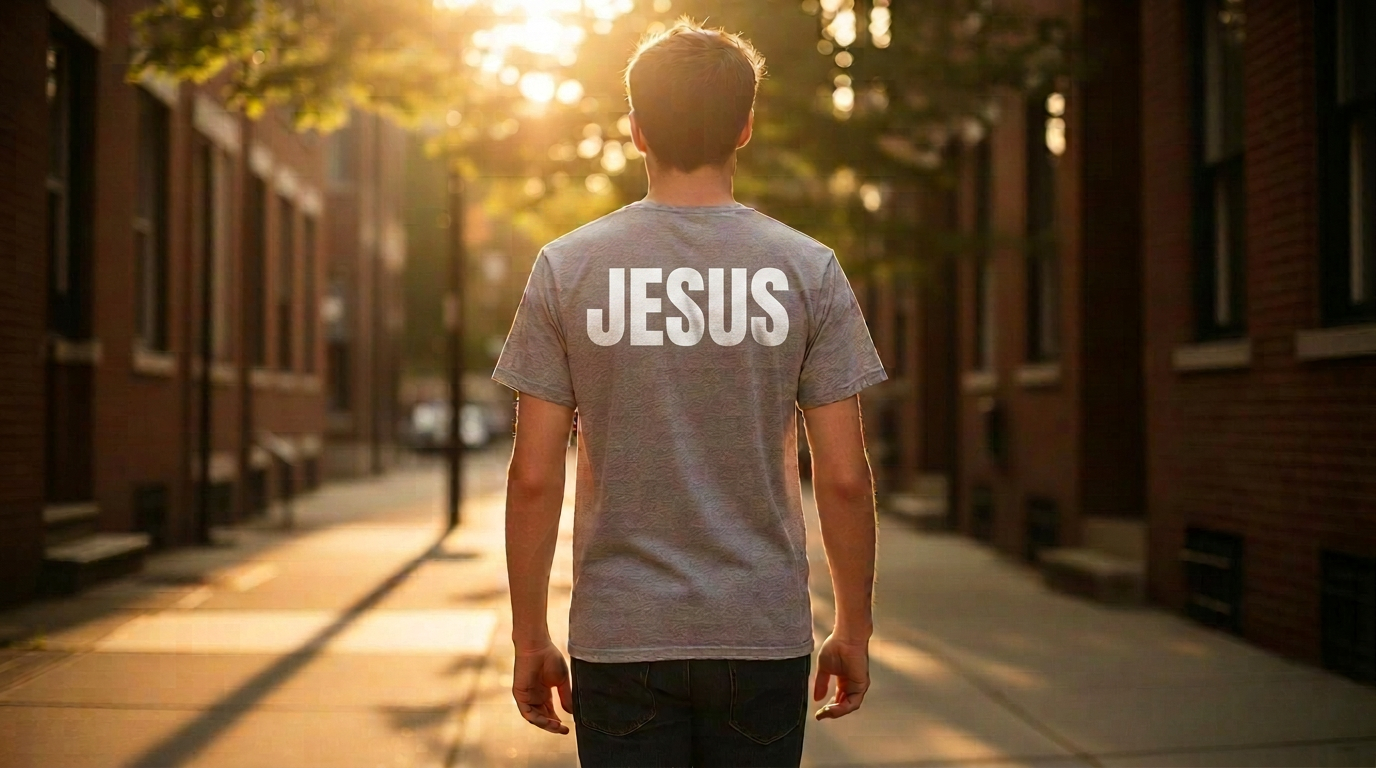
THE ANSWER IS... prints a different sentence on its clothing. The front reads “The Answer Is...” and the back reads “Jesus.” You can see that line on the Jesus shirts, the Christian shirts, and the hoodies. The full collection is in the shop.
Bible verses tied to WWJD
These three verses are from the King James Version, quoted from Bible Gateway. Each one speaks of following the example of Jesus.
1 John 2:6: “He that saith he abideth in him ought himself also so to walk, even as he walked.”
John 13:15, spoken after Jesus has washed the disciples’ feet: “For I have given you an example, that ye should do as I have done to you.”
1 Peter 2:21: “For even hereunto were ye called: because Christ also suffered for us, leaving us an example, that ye should follow his steps.”
The novel’s title follows the language of that third verse. The sentence printed inside In His Steps says “for you” and “leaving you an example.” The King James Version says “for us” and “leaving us an example.” Both wordings call the reader to follow the example of Christ.
Sources
In His Steps by Charles M. Sheldon, Project Gutenberg, ebook 4540. The catalog names Sheldon (1857–1946) and lists the text as public domain in the United States. The 1896 date used above comes from BBC News, Christianity Today, and the Harry Ransom Center. The pledge and the novel’s wording of 1 Peter 2:21 are quoted from the HTML text.
Harry Ransom Center, University of Texas, “In the Galleries: The Origins of WWJD” (April 5, 2012): the 1896 reading at the Central Church of Topeka, the serial in The Advance, the copyright, the title’s link to 1 Peter 2:21, and the 1881/1885 text.
Stephen Tomkins, “What would Jesus do?: The rise of a slogan,” BBC News (December 8, 2011): Sheldon’s 1896 novel, and Janie Tinklenberg’s 1989 youth group at Calvary Reformed Church in Holland, Michigan, including the 300 bracelets and the 30 days.
“WWJD Products Inspire Thousands,” Christianity Today (November 1997): the 1989 Holland, Michigan origin, Sheldon’s novel, and Mike Freestone’s description of the bracelets. Sales figures from that article are not repeated here.
King James Version text of 1 John 2:6, John 13:15, and 1 Peter 2:21, via Bible Gateway. The King James Version is in the public domain.
A few common questions
- What does WWJD mean?
- WWJD stands for “What Would Jesus Do?” Christians use the question as a reminder to measure an ordinary choice against the example of Jesus.
- What does W W J D mean?
- It means the same thing as WWJD. The spaces only separate the four initials in “What Would Jesus Do?”
- Where does “What would Jesus do?” come from?
- Charles M. Sheldon’s 1896 novel In His Steps spread the wording. In the story, a pastor asks volunteers to spend a year asking that question before they act. Project Gutenberg publishes the text.
- Who is connected with the WWJD bracelets?
- BBC News and Christianity Today trace the 1990s bracelets to 1989, when youth leader Janie Tinklenberg had WWJD bracelets made for her youth group at Calvary Reformed Church in Holland, Michigan, after reading In His Steps.
- Which Bible verses connect to WWJD?
- In the King James Version, 1 John 2:6 says a person who abides in Jesus ought to walk as he walked. John 13:15 says Jesus gave an example so his disciples would do as he had done. 1 Peter 2:21 says Christ left an example so that we would follow his steps. Sheldon’s novel uses 1 Peter 2:21.